5 Signs Your VR Fitness Routine Is Actually Working (Beyond the Calorie Count)
Quick Answer: The clearest signs VR fitness is working aren’t the app’s calorie estimate (often inaccurate) — they’re improved real-world stamina, less post-session soreness over time, better accuracy and reach in-game, sustained heart rate in your target zone, and genuinely wanting to play again the next day. Track these instead of the built-in numbers.
VR fitness apps love to flash impressive calorie totals, but those numbers are notoriously unreliable across headsets and games. The better signals are ones you can actually feel and observe.
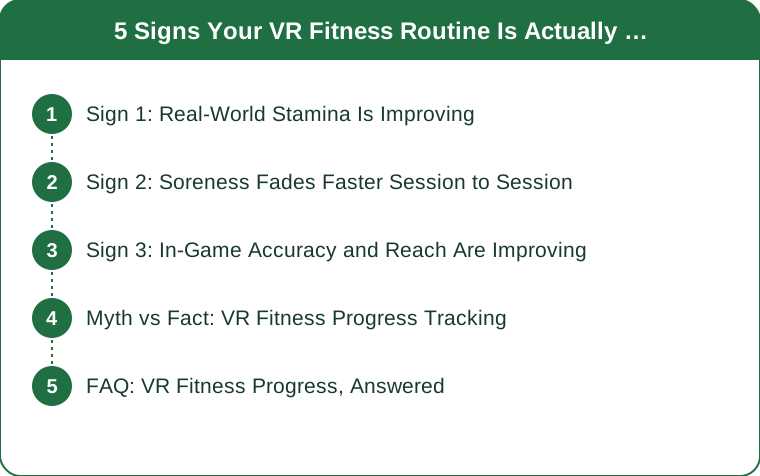
Sign 1: Real-World Stamina Is Improving
If stairs, a brisk walk, or another VR session feel noticeably easier after a few weeks, that’s a far more reliable fitness marker than any in-app number. Cardiovascular improvement shows up outside the headset first, often before you notice a change during the sessions themselves.
Sign 2: Soreness Fades Faster Session to Session
Early VR fitness sessions often leave shoulders and legs surprisingly sore — a sign the movement patterns are new and genuinely working muscles. As soreness resolves faster and shows up less intensely over a few weeks, that’s your body adapting, which is the actual goal, not a lack of effort.
Sign 3: In-Game Accuracy and Reach Are Improving
Boxing and rhythm-based VR games track your accuracy and reach explicitly — watching these numbers trend upward over weeks reflects real gains in coordination, reaction time, and range of motion, all of which transfer to general fitness and mobility.
Myth vs Fact: VR Fitness Progress Tracking
Myth: The app’s calorie burn number is the best way to measure progress. Fact: These estimates vary wildly between headsets and games and are frequently inflated. Heart rate consistency and real-world stamina are far more reliable.
Myth: If you’re not drenched in sweat, it’s not working. Fact: Sweat output depends heavily on room temperature and individual physiology — a cooler room with good airflow can mean a genuinely effective session with far less visible sweat.
FAQ: VR Fitness Progress, Answered
Should I trust my VR headset’s calorie counter at all?
Treat it as a rough relative trend, not an absolute number — if it’s rising week to week for the same routine, that’s more meaningful than the specific figure.
How long does it typically take to notice real fitness improvements from VR workouts?
Most people report noticeable stamina and soreness-recovery improvements within 3-4 weeks of consistent sessions, similar to other moderate-intensity cardio training.
Does a heart rate monitor actually help with VR fitness tracking?
Yes — a chest strap or wrist monitor paired with the headset gives a far more reliable effort measure than the game’s built-in estimate, especially for tracking whether you’re staying in an effective heart rate zone.
TL;DR:
- Skip the in-app calorie count — it’s one of the least reliable progress markers
- Real-world stamina improvement and faster soreness recovery are the strongest signs it’s working
- In-game accuracy and reach improvements reflect genuine coordination and mobility gains
- A dedicated heart rate monitor beats the headset’s built-in estimate for tracking effort
If you’re playing again the next day without dreading it, that consistency is doing more than any single session’s calorie count.
Keep Reading
This article is for general informational and styling purposes only. Fit, sizing, and product availability may vary.