5 Signs Your VR Workout Is Easier Than It Feels
Quick Answer: VR inflates perceived effort through visual and cognitive load, so a moderate session can feel maximal. The five reliable signs your intensity is actually too low are: your heart rate settles fast, you’re not breathing hard between rounds, your scores plateau while your effort feels constant, you never sweat through a shirt, and you can hold a conversation the whole time.
VR fitness has an honest strength - it makes hard work fun enough to repeat. It also has a specific blind spot: the game gives you feedback on accuracy and timing, not on effort. Here are the five signs that gap has opened up on you.
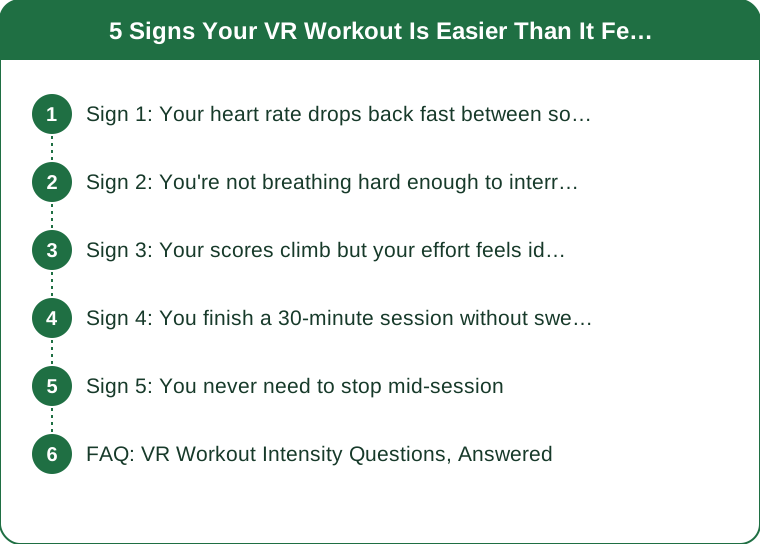
Sign 1: Your heart rate drops back fast between songs
The clearest signal. If your heart rate falls 30 or more beats within 30 seconds of a track ending, you weren’t near your working ceiling during it.
Genuine moderate-to-vigorous work leaves your heart rate elevated for a minute or more after stopping. A fast drop means you were in a comfortable aerobic zone the whole time, regardless of how frantic the arrows looked.
The fix: add resistance rather than speed. Light wrist weights - 1 to 2 lbs each, no more - dramatically change the cost of the same movement pattern without changing the game. Alternatively, shorten your rest between tracks to 15 seconds so heart rate never fully recovers.
Sign 2: You’re not breathing hard enough to interrupt a sentence
The talk test is unglamorous and extremely reliable. If you can speak a full sentence comfortably at any point during a track, you’re in light-to-moderate territory.
VR’s problem here is that the headset isolates you from your own noise. You don’t hear your breathing over game audio the way you’d hear it on a treadmill, so the usual self-check disappears.
The fix: pull one ear of your headphones off for a single track, or turn the volume down 30%. Most people are genuinely surprised by how quiet their breathing is.
Sign 3: Your scores climb but your effort feels identical
Improving accuracy at constant perceived effort is a skill adaptation, not a fitness one. It’s satisfying and it’s real, but it means you’ve gotten better at the game while your body has stopped being asked for more.
This is the most common plateau in VR fitness and it usually hits around the two-month mark - exactly when people conclude VR fitness ‘stopped working.’
The fix: move up a difficulty tier even though your accuracy will fall. Deliberately playing above your skill level restores the physical demand, because you’re reaching further, moving faster, and recovering from misses. Accept a worse score for three weeks.
Sign 4: You finish a 30-minute session without sweating through anything
Sweat is an imperfect measure - room temperature, humidity, and individual variation all matter. But it’s useful as a change signal. If you used to finish sessions damp and now you don’t, at the same room temperature, your intensity has drifted down.
VR sessions in air-conditioned rooms in late summer confuse this signal, so compare like with like. Same room, same time of day, same length.
The fix: check whether your movement range has quietly shrunk. Most people’s punches, squats, and dodges get smaller and more efficient over months - technically better play, physically less work. Consciously exaggerating range of motion for one session usually restores the effort immediately.
Sign 5: You never need to stop mid-session
If you can play 45 minutes straight without wanting a break, you’re doing steady-state light cardio. That’s genuinely fine - it’s activity, it counts, and it’s better than the couch. But it isn’t the vigorous training most people believe they’re getting.
The intensity that produces meaningful cardiovascular adaptation generally requires intervals you can’t sustain indefinitely.
The fix: build actual intervals. Play three tracks at maximum honest effort - including bigger movements, deeper squats, full extension - then take a real 90-second break. Repeat four times. A 20-minute session structured this way outperforms 45 minutes of comfortable play, and you’ll know the difference within the first round.
FAQ: VR Workout Intensity Questions, Answered
Do VR headset calorie estimates mean anything?
Treat them as directional at best. In-game estimates typically use head and controller movement, which underestimates lower body work and overestimates arm-heavy play. A chest-strap monitor gives you far more useful data.
Are wrist weights safe in VR?
Keep them light - 1 to 2 lbs. Heavier weights change your swing mechanics enough to increase shoulder and elbow strain, especially in fast rhythm games where you can’t slow down to compensate.
Is low-intensity VR still worth doing?
Absolutely. Consistent moderate movement has real value, and VR’s biggest advantage is that people actually keep doing it. The point isn’t that easy sessions are worthless - it’s that you should know which one you’re doing.
TL;DR:
- VR inflates perceived effort, so moderate sessions can feel maximal
- Fast heart-rate recovery, easy breathing, and no sweat are the honest signals
- Rising scores at constant effort means skill adaptation, not fitness adaptation
- Move up a difficulty tier and accept worse scores for three weeks
- Structure real intervals: 3 hard tracks, 90-second break, repeat four times
The game scores your accuracy. Nothing in the headset is scoring your effort - that part is on you.
Keep Reading
This article is for general informational and styling purposes only. Fit, sizing, and product availability may vary.