5 VR Fitness Checks When You Share Your Space With Someone
Quick Answer: In a shared home, the main VR fitness risks are not furniture — they are people who enter your play space while you cannot see them, boundaries drawn for a room that gets rearranged, noise travelling to someone else’s evening, headset hygiene between users, and sweat and heat in a room somebody else has to use afterwards. Each has a five-minute fix, and each one is worth doing before the session rather than after the incident.
You cannot see them. Assume they cannot see the problem either.

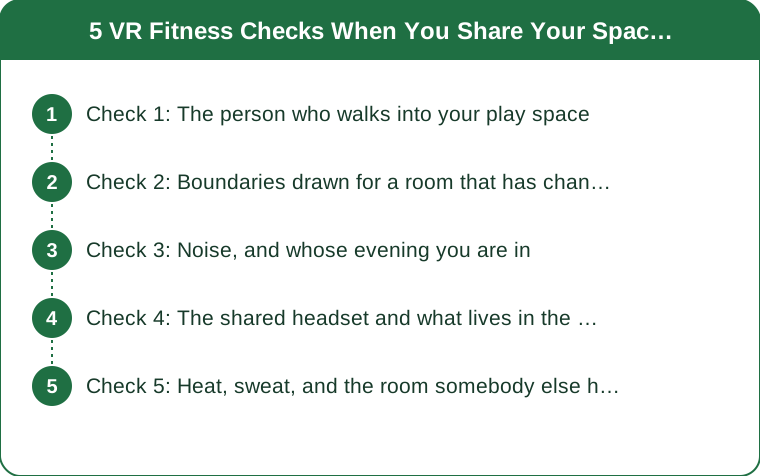
Check 1: The person who walks into your play space
The single most likely cause of a real injury, and it is entirely preventable.
In VR you are moving fast with full arm extension and no external vision. A housemate walking behind you to reach the kitchen is invisible to you and, from their perspective, is just walking through a room. The collisions that result are genuinely forceful — a punching or swinging motion at full speed into someone’s face is a serious event.
Guardian boundaries protect you from walls. They do not protect anyone else from you.
What to do:
Agree a visible signal. A closed door, a sign, a light, or a rule as simple as: if the headset is on, do not cross the marked area. Verbal agreement, once, is far more effective than an assumption.
Physically block the walk-through route if your play space sits in a path between rooms. A chair moved into the doorway is enough — the point is that someone stops and thinks rather than walks straight through.
Use passthrough more. Turning on passthrough when someone speaks to you is a habit worth building, so conversations do not happen with you swinging at head height.
Position yourself facing the entrance where the layout allows, so a person coming in enters your boundary in front of you rather than behind.
Brief guests explicitly. Regular housemates learn quickly; visitors do not know that walking up behind someone in a headset is dangerous. Say it out loud.
Check 2: Boundaries drawn for a room that has changed
Shared rooms move. Your guardian does not.
Anyone else living in the space rearranges it. A chair pulled out, a drying rack in the corner, a delivery box by the sofa, a coffee table moved six inches. Your boundary was drawn around the room as it was last week.
A boundary is only accurate if the room matches it. Guardian systems warn you when you approach a virtual line; they have no idea a stool now sits inside it.
The habit that fixes this: a ten-second visual sweep before every session, headset in hand rather than on your face. Look at the floor specifically. Most collisions in shared spaces are with low objects that were not there yesterday.
Redraw the boundary whenever the furniture moves, not just when the system prompts. Redrawing takes under a minute and it is the difference between a warning and a shin.
Draw it smaller than you think you need. A tight boundary is annoying and it survives a chair being moved four inches. In a shared space, allow more margin than you would alone.
Watch the ceiling and light fittings too, particularly in older homes with low fixtures. Games with overhead reaching are the usual culprit, and pendant lights over dining tables are the usual victim.
Floor surface matters as much as the perimeter. Rugs that slide, cables from someone else’s laptop, and pet bowls all appear in shared rooms without notice.

Check 3: Noise, and whose evening you are in
The complaint that ends home VR fitness sooner than anything else.
Jumping and lunging transmit through floors dramatically. Impact noise travels through structure rather than air, so a downstairs neighbour or someone in the room below hears it far more clearly than anything you might expect.
Your own audio is not the problem — your feet are. The person downstairs cannot hear your headset. They can hear every landing.
What genuinely helps:
An interlocking foam or rubber mat under the play space. This is the highest-value purchase for shared-building VR fitness. It reduces impact transmission substantially and it also marks the boundary underfoot, which helps you stay centred.
Choose lower-impact games in unsociable hours. Rhythm and boxing titles with mostly upper-body movement transmit far less than anything with jumping.
Agree hours rather than negotiating each time. A standing arrangement about when the jumping happens removes the friction entirely.
Your own voice is louder than you think. People in headsets talk, grunt, and occasionally shout at a game with no sense of their own volume. This is the noise complaint most people never consider.
Use headphones rather than headset speakers in a shared room, both for your housemate’s sake and because it keeps you from raising your own volume against ambient noise.
Check 4: The shared headset and what lives in the facial interface
If more than one person uses it, hygiene stops being optional.
The facial interface sits against skin that has been sweating heavily, in a warm, enclosed, dark space. Stock foam interfaces absorb sweat and do not dry quickly, and shared use is associated with skin irritation and eye infections.
Conjunctivitis spreading between users of a shared headset is a documented and entirely avoidable problem.
What to sort:
Get a silicone or leatherette cover for the facial interface. They wipe clean, they do not absorb sweat, and they cost very little. This is non-negotiable for a shared headset.
Wipe after every session, not at the end of the day. A pack of lens-safe wipes stored with the headset makes this happen; a bottle in another room means it does not.
Never use alcohol wipes on the lenses. They can damage lens coatings. Use a dry microfibre cloth for lenses and the appropriate wipes for the interface only.
Individual interfaces for regular users if two people both use it often. They swap in seconds and remove the issue entirely.
Let it dry before it goes in a case. Sealing a damp headset into a case is how it starts to smell, and how the foam degrades.
Anyone with an eye infection should not use a shared headset, and the interface needs cleaning thoroughly before the next person does.
Check 5: Heat, sweat, and the room somebody else has to sit in
The session ends; the room stays.
VR fitness produces genuine heat and sweat, and the headset itself traps heat around the face, which reduces evaporative cooling exactly where you need it. A closed room used for a 30-minute session becomes noticeably warm and humid.
In a shared home, that room is often the living room somebody else uses afterwards.
Ventilate before, during, and after. A window open before you start does more than one opened afterwards, and cooler autumn air makes this far easier than it was in July.
A fan is the single best VR fitness accessory. It cools you directly, keeps the headset lenses from fogging, and moves the humid air out of the space. Position it to blow across your face rather than at your back.
Fogging is the visible symptom of the same problem. Lenses fog when warm humid air meets cooler glass, and airflow plus a slightly cooler room fixes it better than any anti-fog product.
Put a towel down and use it. Sweat onto a shared carpet or sofa is the kind of thing that quietly ends the arrangement.
Sort the room out afterwards. Window open for ten minutes, mat wiped, headset wiped and left to dry, furniture put back. Five minutes of reset is what keeps a shared space available to you.
As the weather cools, the ventilation question changes. Opening a window mid-session becomes genuinely cold for whoever else is in the flat. Ventilate hard before and after instead, and rely on a fan during, which keeps you cool without chilling the whole room.
TL;DR:
- The biggest shared-space risk is a person walking into your swing radius, so agree a visible signal and block the through route.
- Boundaries drawn last week do not know about today’s furniture; sweep the floor visually and redraw whenever the room changes.
- Impact noise travels through floors — a foam mat and agreed hours solve more conflict than anything else.
- A wipeable facial interface and a wipe after every session are non-negotiable when more than one person uses the headset.
Agree the walk-in rule with your housemate today. It takes one sentence and it is the only item on this list that prevents an actual injury.
Keep Reading
This article is for general informational and styling purposes only. Fit, sizing, and product availability may vary.