5 VR Fitness Mistakes That Only Show Up After Month Three
Quick Answer: Early VR fitness works because everything is new - the novelty supplies the intensity, the motivation, and the attention. By month three the novelty is gone, and what remains is whatever structure you built underneath it. The five problems below all start in week one and only become visible around week twelve. Each has a fix that takes minutes.
Month one is easy and tells you nothing.
Month three is where you find out what you actually built.
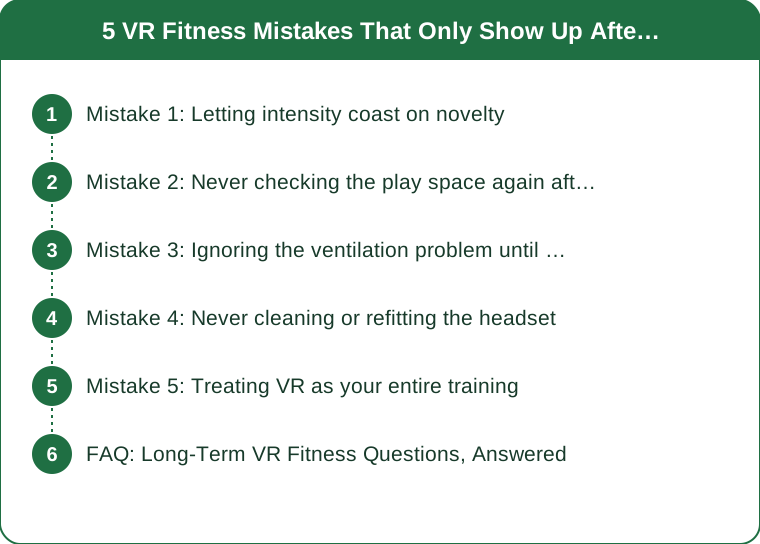
Mistake 1: Letting intensity coast on novelty
The most common one, and the hardest to notice from the inside.
In the first weeks, unfamiliarity does the work. Learning the movements, reacting to new patterns, and being slightly out of your depth all raise your effort without you choosing to raise it. The novelty is supplying intensity, and you are getting the benefit without managing it.
By month three you know the songs, the patterns, and the levels. You move more efficiently, you anticipate rather than react, and your heart rate at the same nominal difficulty is meaningfully lower. You are doing the same workout and getting less from it - which is skill acquisition working exactly as it should.
It feels like a plateau in fitness, and it is a plateau in stimulus. The session still feels familiar and pleasant, so nothing prompts the change. A pleasant workout is often an easy one.
The fix is a scheduled difficulty bump. Every three to four weeks, move up a level or add a modifier, regardless of whether it feels necessary. Put it on a calendar rather than waiting to feel under-challenged, because that feeling arrives months late.
Mistake 2: Never checking the play space again after setup
The boundary you drew in month one no longer describes the room.
Rooms drift. A chair gets moved two feet, a box arrives and stays, a rug slides. Nobody re-checks a boundary that has not caused a problem yet, which is how the first collision happens in month four rather than week one.
Your movement expands as you improve. Early sessions are cautious and small; by month three you are lunging, ducking, and reaching much further. The space that was ample for a beginner is tight for someone competent - the room did not shrink, your range grew.
Seasonal changes matter too. Autumn brings furniture rearrangement, heating units, and darker rooms, all of which change the space. Low light also affects headset tracking, which is a separate and less obvious problem.
The fix is a thirty-second sweep before each session. Look at the floor, look behind you, confirm the boundary matches the room today. A habit, not an event - and considerably cheaper than a bruised hand and a broken lamp.
Mistake 3: Ignoring the ventilation problem until it ends sessions
The room gets hot, the headset fogs, and the sessions quietly get shorter.
VR fitness happens in a closed room with a device on your face. Heat builds fast, there is no airflow across your skin, and the headset traps heat and moisture directly against you. The thermal load is higher than the same movement without a headset, which surprises people.
The failure mode is subtle. You do not decide to stop early - the session just becomes less pleasant, the lens fogs, and forty minutes becomes twenty-five over several weeks. The habit degrades rather than breaking, which is why it goes unnoticed.
Late summer into early autumn is when it bites hardest. Rooms hold afternoon heat well into the evening, and evening is when most people train. An eight p.m. session in an upstairs room is a different workout from a morning one.
The fix is a fan aimed at your face and torso, plus a cracked window. The fan handles the airflow, the window handles the humidity. Together they extend session length more than any motivational strategy.
Mistake 4: Never cleaning or refitting the headset
Hygiene and fit both degrade slowly enough to stay invisible.
Facial interfaces absorb sweat continuously. After three months of regular sessions, an uncleaned interface is unpleasant and can contribute to skin irritation. Nobody notices gradual, which is exactly the problem.
The fit loosens as the padding compresses. A headset that was snug in week one sits slightly lower and slightly looser by month three, which shifts the lenses and blurs the image. People assume the display got worse when in fact the position did.
A poor fit changes how you move. If the headset shifts during quick movements, you unconsciously moderate your head movement to keep it stable. Your workout gets smaller to protect the fit without you deciding to.
The fix is a wipeable interface cover and a monthly refit. Wipe after each session, and once a month re-tighten the straps and check the lens position properly. Five minutes a month restores both the image and the range of motion.
Mistake 5: Treating VR as your entire training
It is genuinely good cardio and it is not a complete programme.
Most VR fitness is dominated by upper-body and lateral movement. Arms, shoulders, and side-to-side footwork get plenty of work; loaded lower-body strength and heavy pulling patterns get almost none. The gaps are consistent across titles because the format shapes them.
By month three the imbalance can show up. Shoulders that are well conditioned and a posterior chain that is not is a common pattern, and it can produce the shoulder and neck discomfort many long-term users report. The headset weight contributes to the neck part.
Repetition of the same patterns is the underlying issue. Doing the same movement thousands of times without a counterbalancing pattern is how overuse problems develop in any activity. This is not specific to VR - it is just easy to miss when it does not feel like training.
The fix is two short strength sessions a week. Squat or hinge, a horizontal pull, and some direct neck and upper-back work. Twenty minutes twice a week covers the gaps and makes the VR sessions feel better too. Persistent shoulder or neck pain rather than ordinary soreness is worth having assessed. This is general information, not medical advice.
FAQ: Long-Term VR Fitness Questions, Answered
Why did I stop sweating as much as I did at the start?
Almost always improved efficiency rather than declining fitness - you have learned to move economically. Raise the difficulty rather than adding time, which is the more common and less effective response.
Is VR fitness enough on its own?
As cardio, for many people, yes. As a complete programme, no - loaded lower-body strength and pulling patterns are the reliable gaps, and two short sessions a week fill them.
How often should I clean the headset?
Wipe the interface after every session and do a proper clean weekly. A washable or wipeable cover makes this a five-second habit rather than a chore you skip.
TL;DR:
- Novelty supplies your early intensity - when it fades around month three, the stimulus drops without you noticing.
- Schedule a difficulty bump every three to four weeks instead of waiting to feel under-challenged.
- Re-check the play space each session - rooms drift and your movement range grows.
- A fan and a cracked window extend session length more than any motivational fix.
- Add two twenty-minute strength sessions a week to cover the lower-body and pulling gaps.
Before your next session, aim a fan at your face and bump the difficulty one level. Two changes, about a minute, and month four looks nothing like month three.
Keep Reading
This article is for general informational and styling purposes only. Fit, sizing, and product availability may vary.