5 VR Fitness Room Checks as the Weather Cools
Quick Answer: Cold rooms cause more lens fogging (warm face meets cold lens), shorter battery life (lithium cells lose usable capacity in the cold), and worse tracking if you have closed the curtains and dropped the light level. Five checks: pre-warm the headset, raise the room light, re-run the boundary, plan for shorter battery, and keep ventilating despite the cold.
Same room. Same game. Same you.
And the lenses fog in the first ninety seconds, the battery dies twenty minutes early, and the guardian keeps nagging.
All five fixes are free.

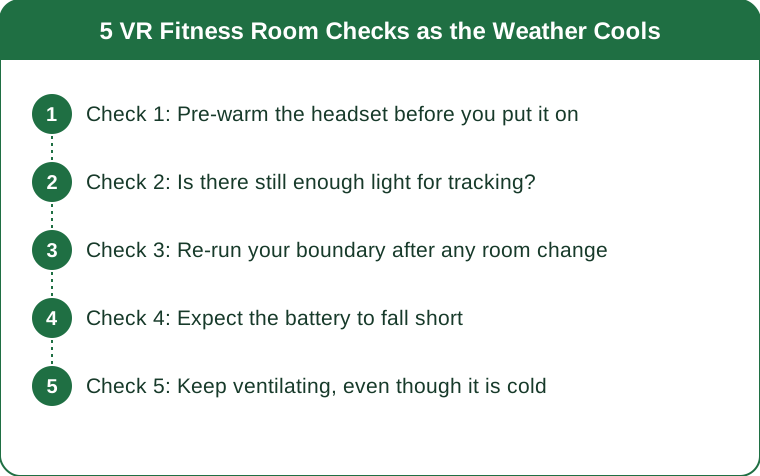
Check 1: Pre-warm the headset before you put it on
Fogging is a temperature difference, not a humidity problem — and the difference gets bigger as the room gets colder.
When your warm, damp face meets a cold lens, moisture condenses on the lens surface instantly. In a 24C room in summer the gap between your skin and a headset sitting on the shelf is small. In a 16C room the gap is large, and the fogging is immediate and severe.
Four things that fix it, in order of effectiveness.
Bring the headset up to room temperature before you start. If it lives in a cold cupboard or near an exterior wall, move it into the warm part of the room 20-30 minutes before your session. This alone solves most autumn fogging.
Wear the headset loosely for the first two minutes, or hold it against your face without strapping it, so the lenses warm gradually rather than getting hit with warm breath all at once.
Point a fan at yourself, not at the headset. Airflow across your face reduces the moisture arriving at the lens. Airflow across a cold lens keeps it cold, which makes fogging worse.
And check your facial interface. A foam interface that has absorbed sweat over the summer holds moisture right against the lens. A washable silicone interface is a genuine upgrade for anyone who sweats, and it dries in minutes rather than hours.
Never use household glass cleaner on VR lenses — they have coatings that solvents strip permanently. A dry microfibre cloth, in circles from the centre out.
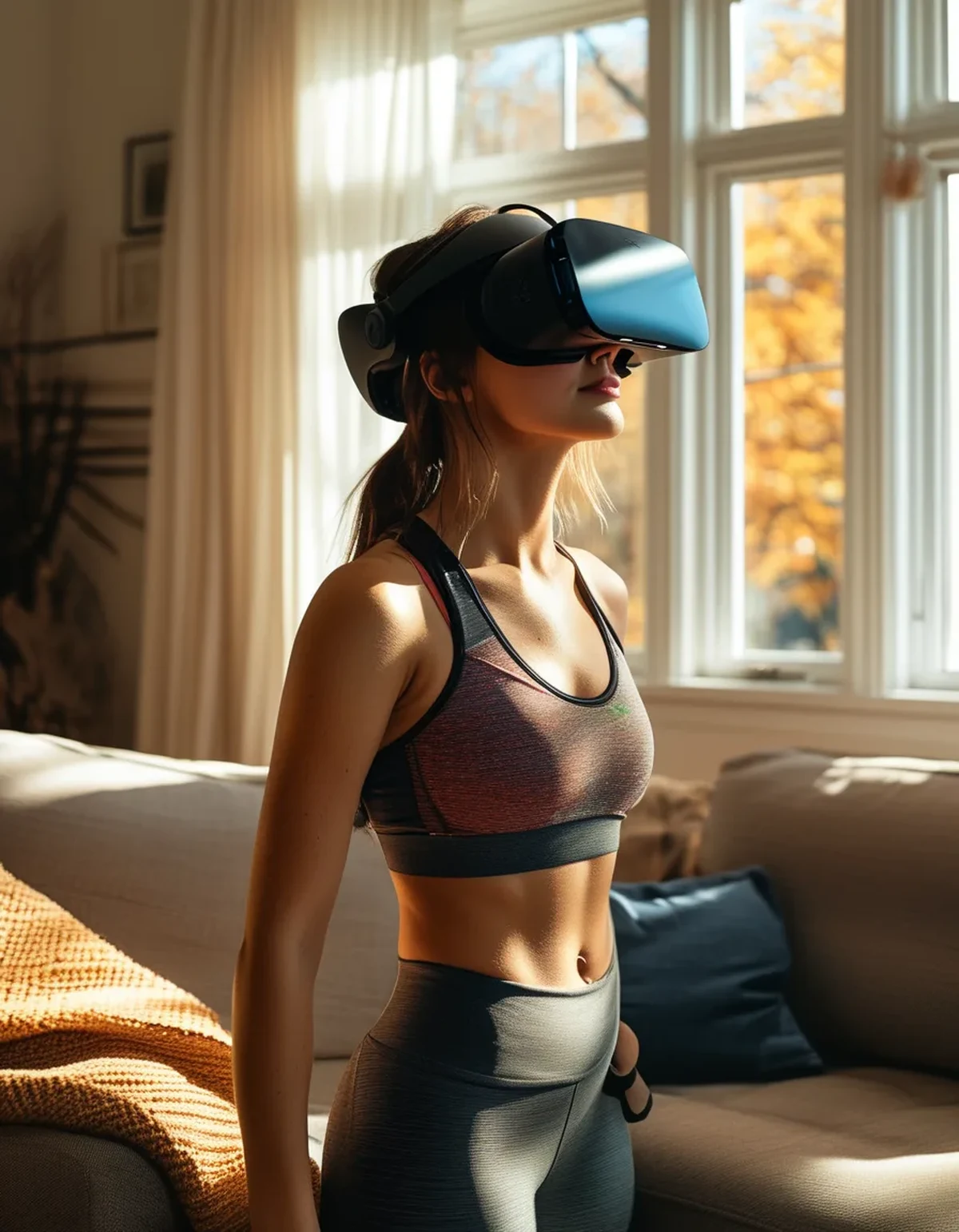
Check 2: Is there still enough light for tracking?
Inside-out tracking works by watching your room, and autumn quietly removes the light it needs.
The cameras on the headset find visual features — furniture edges, patterns, corners — and use them to work out where you are. That requires reasonable light and visual detail. Three things change as the season turns.
Sunset arrives during your session. A room that was well lit when you started is dim by minute thirty, and tracking degrades progressively rather than failing outright, so it feels like drift or judder rather than an obvious error.
Curtains close. Closing heavy curtains against the cold removes both light and the visual detail of a window frame, which is often the strongest feature in a room.
Lamps replace daylight. A single warm lamp in a corner produces uneven lighting with deep shadows, and shadowed areas give the cameras nothing to lock onto.
The fixes are cheap. Turn on the main overhead light rather than relying on daylight, even in the afternoon. Aim for even light rather than bright light — two moderate sources beat one bright one. Avoid pointing a lamp toward the headset, which can dazzle the cameras. And if your play area faces a blank wall, adding literally anything with visual texture — a poster, a shelf, a patterned throw — measurably improves tracking stability.
Check 3: Re-run your boundary after any room change
Autumn rearranges rooms, and a stale boundary is the most common cause of the equipment collisions that end VR fitness habits.
The boundary you drew in July assumed July’s furniture. Since then you may have moved a chair closer to the radiator, added a drying rack, brought a side table in from a balcony, or simply pushed the sofa back six inches. None of that updates the guardian.
Four habits worth building.
Redraw the boundary at the start of every session, not just when the headset prompts. It takes about fifteen seconds and it forces you to actually look at the room.
Walk the perimeter with your arms out before you start. Your boundary is drawn at floor level; your fists travel at head height and reach further. The classic VR fitness injury is a knuckle into a door frame that the floor-level boundary said was clear.
Leave a genuine margin. A boundary drawn right at the wall gives you no reaction time. 30-50cm of buffer on each side is the difference between a warning and a wall.
And check what is above you. Low ceilings, pendant lights and ceiling fans do not appear in a boundary at all. Overhead is the one dimension the system does not protect you in, and autumn is when the lamp gets switched back on and moved.
Check 4: Expect the battery to fall short
Lithium-ion cells deliver less usable capacity in the cold, and a headset stored in a cool room starts the session at a disadvantage.
The effect is real and it is temporary — the capacity comes back when the cell warms up — but it means a headset that comfortably ran a 45-minute session in summer may warn you at 30 minutes in a cold room. People usually blame battery degradation when the room is the variable that changed.
Five practical responses.
Store and charge the headset in the warm part of your home, not a cold hallway or near an exterior wall.
Charge to full immediately before the session rather than the night before, so the cell is warm from charging when you start.
Use a battery strap or a power bank if you regularly go beyond 40 minutes. The counterweight also improves comfort, which matters more in longer autumn sessions.
Do not charge a very cold headset immediately. Charging lithium cells below roughly 0C can damage them permanently. If the device has been somewhere genuinely cold, let it reach room temperature first.
And plan the session around it. Knowing you have 35 usable minutes rather than 50 lets you structure a complete workout instead of getting cut off mid-set — which is the thing that actually breaks the habit.
Check 5: Keep ventilating, even though it is cold
The instinct in autumn is to shut everything, and VR fitness is one of the few activities where that backfires immediately.
A VR workout generates real heat and sweat in a small area, and unlike a gym there is no air handling. In a sealed room three things happen fast: humidity rises, which makes fogging dramatically worse; the room warms unevenly, so you overheat while the walls stay cold; and the air gets stale enough to affect how hard the session feels.
Four ways to ventilate without freezing.
Crack a window 5-10cm during the session and close it after. Even a small gap moves a surprising amount of air, and you are generating enough heat not to feel it once you are moving.
Use a fan on low, aimed at you. It does more for perceived comfort and fogging than a colder room does, at no heating cost.
Ventilate for ten minutes after you finish, with the door open. This is when the humidity in the room peaks, and it is what stops condensation forming on cold windows and walls — a genuine mould risk in a small room used for daily workouts.
And wipe the facial interface down every session. Warm damp foam in a cool room is exactly the environment for skin irritation, and it is a two-second job with an alcohol-free wipe. A second interface, rotated, means you always start with a dry one — which turns out to be the small upgrade that makes cold-season VR fitness pleasant rather than tolerable.
TL;DR:
- Pre-warm the headset 20-30 minutes before use — fogging is a temperature gap, and cold rooms widen it.
- Turn the main light on. Inside-out tracking needs even light and visual detail, and autumn removes both.
- Redraw the boundary every session and walk it with arms out; check overhead, which the system ignores.
- Expect shorter battery in the cold — charge just before, store warm, and never charge a freezing headset.
- Keep ventilating: a 5-10cm window gap, a fan aimed at you, and ten minutes of airflow afterward.
Do the pre-warm one tonight. It is the check that fixes the most annoying problem for the least effort.
Keep Reading
This article is for general informational and styling purposes only. Fit, sizing, and product availability may vary.