VR Workout Nausea: How to Train It Away in Two Weeks
Quick Answer: VR workout nausea is a sensory mismatch: your eyes report motion your inner ear cannot confirm, and your brain responds the way brains do to conflicting motion signals. Most people can train it down dramatically in one to two weeks with short, frequent sessions that end before symptoms build, stationary-style games first, comfort settings on, a fan on your face, and a properly adjusted headset. Pushing through heavy nausea is the one strategy that reliably backfires.
Sailors call it getting your sea legs. Same brain, same fix, better soundtrack.
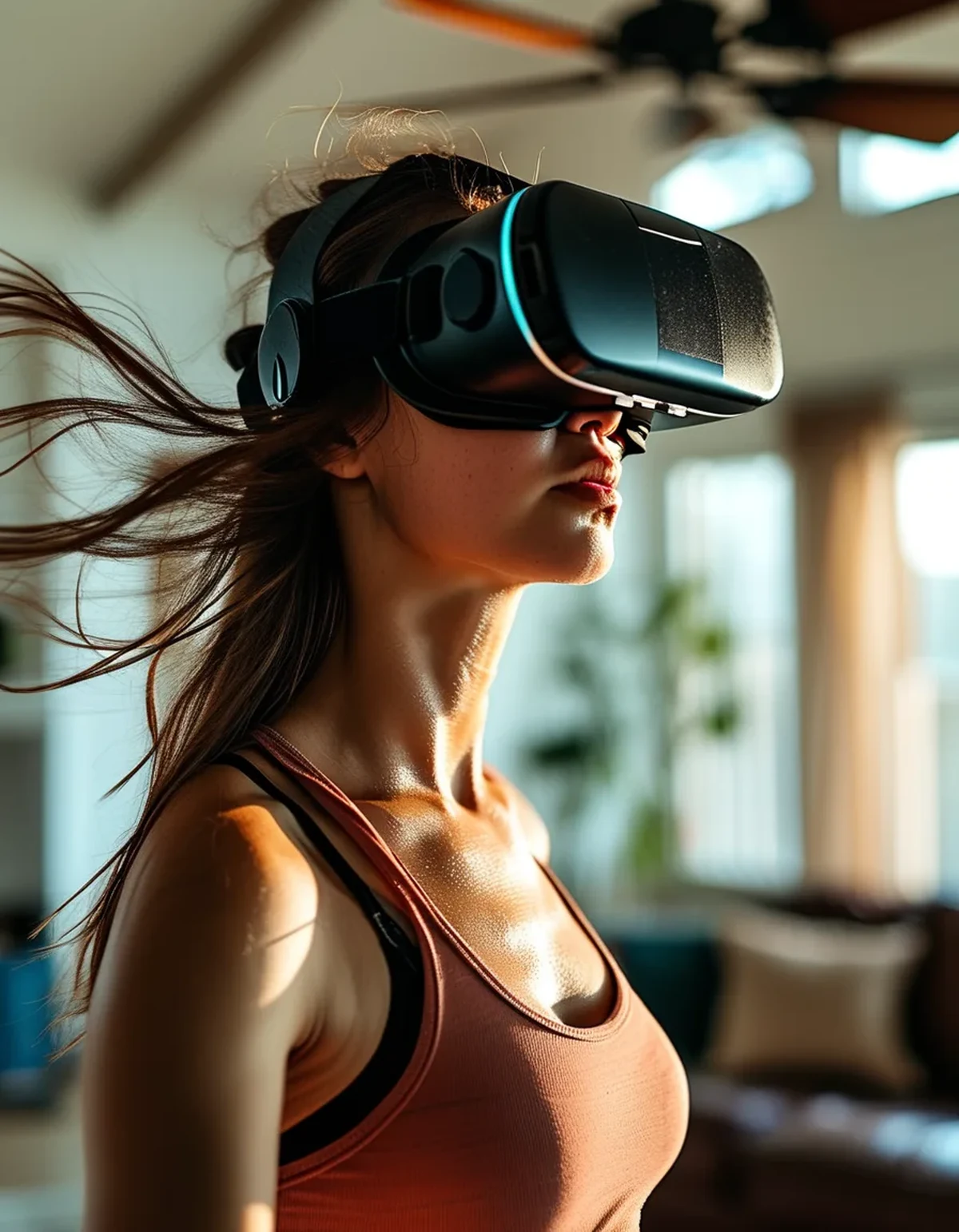
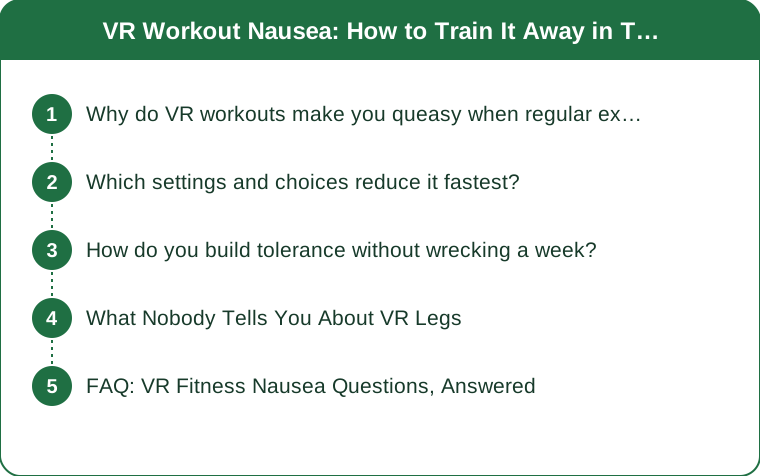
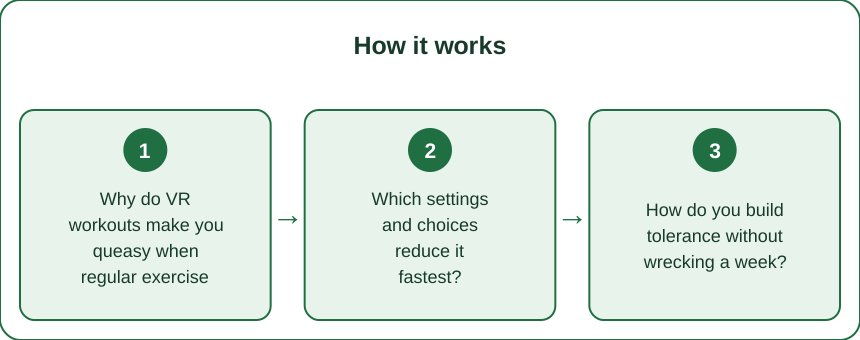
Why do VR workouts make you queasy when regular exercise never does?
Because the conflict is not effort — it is testimony.
Your balance system cross-checks three witnesses: eyes, inner ear, and body position sense. In ordinary exercise they agree. In VR, your eyes swear you are gliding, turning, or falling while your inner ear reports standing in a living room — and sustained disagreement between those witnesses is the classic trigger for nausea, sweating, and that gray unsettled feeling.
Artificial locomotion is the worst offender. Games that slide or rotate your viewpoint while you stand still create maximum mismatch. Boxing and rhythm games, where you physically move and the world stays put, create almost none — which is why one VR workout wrecks you and another feels fine.
Latency and fit amplify everything. A headset that renders your head turn a few milliseconds late, sits loose, or is set to the wrong lens spacing adds a constant low-grade wrongness under whatever the game is doing. A blurry or swimmy image is a nausea multiplier, not just an annoyance.
Workout conditions stack the deck further. Heat, a stuffy room, dehydration, and exertion all lower your nausea threshold on their own; VR fitness combines them inside a face-sealed device.
Susceptibility is real and varied. People prone to carsickness tend to feel VR sooner, and sensitivity differs person to person for reasons including how well the headset’s optics match your eyes. None of it predicts fitness or toughness — and nearly all of it responds to training.
Which settings and choices reduce it fastest?
Stack every comfort advantage first. Adaptation goes faster when the dose is smaller.
Start with stationary-play games. Boxing, rhythm, and standing HIIT titles where your real movement is the movement. Save anything with artificial sliding or flying for week two and beyond — game choice is the single biggest nausea dial you control.
Turn comfort settings on and leave them on. Vignetting that narrows your view during movement, teleport or snap-turning instead of smooth rotation, and any stable cockpit or horizon option. They exist because they work; there is no medal for raw mode.
Fit the headset like it matters, because it does. Adjust the lens spacing to your eyes until text is crisp, tighten the strap so the sweet spot stays put mid-squat, and keep the lenses clean. Five minutes of fit setup removes the constant background blur that primes queasiness.
Protect your frame rate. Stutter is motion-sickness fuel — close background apps, keep the headset updated, and prefer smooth performance over pretty settings where the option exists.
Point a fan at your face. Cool moving air on the face measurably eases motion sickness — the same reason the car window helps — and it fights lens fog and workout heat at the same time. The fan is the best dollar-for-dollar anti-nausea device in VR fitness.
Mind the stomach and the room. Lightly fed beats empty or full, hydrated beats not, and a cool ventilated room beats a warm sealed one. If you like ginger for travel queasiness, it is a reasonable, gentle sidekick here too. Dress like it is cardio, because it is — a sweat-wicking top and leggings keep the heat side of the equation calm.
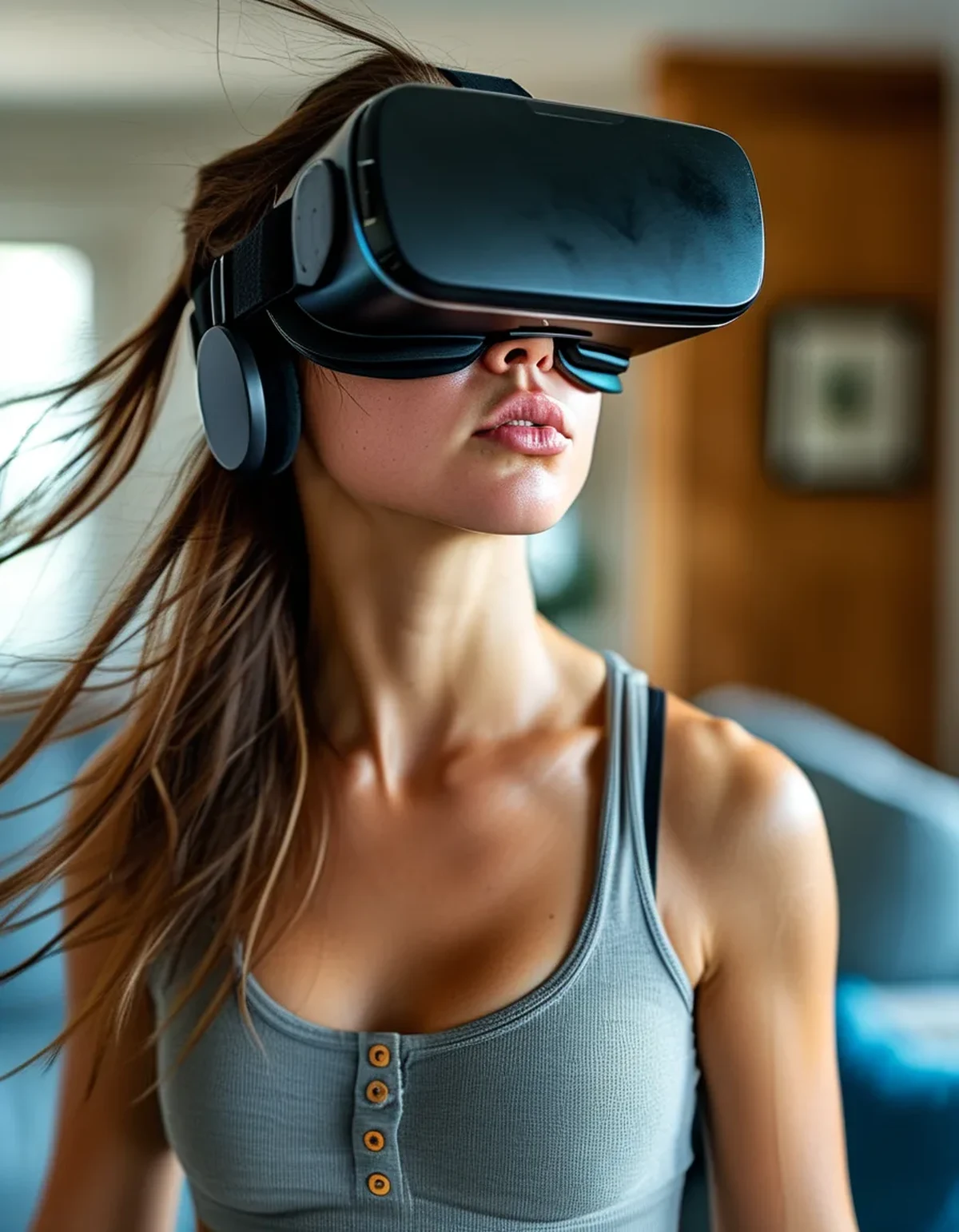
How do you build tolerance without wrecking a week?
Short, frequent, and always stopping early. Adaptation is a dose-response you control.
The protocol that works for most people:
Days 1 to 4: 10 to 15 minutes of a stationary game, daily or near-daily. End while you still feel fine — the session limit is your first hint of symptoms, not your schedule.
Days 5 to 9: stretch to 20 to 30 minutes as comfort allows. Add gentle movement mechanics if your games have them, comfort settings still on.
Days 10 to 14: most people can now do full workouts in their chosen titles. Introduce smoother locomotion in small doses only if your library needs it, one setting relaxed at a time.
The one rule that outranks the schedule: stop at the first real symptom. Mild fleeting oddness that passes in seconds is fine; building queasiness, sweating, or that gray feeling means the session ends now. Pushing through teaches your brain that VR predicts feeling awful, which is the exact association you are trying to erase. People who bail early adapt faster than people who tough it out — this is the counterintuitive core of the whole process.
Frequency beats duration. Five short exposures spread across a week train tolerance better than one long miserable Saturday.
After a heavy session, give your brain a landing. Sit for a minute, look at the real room, and skip driving immediately after long intense sessions while any disorientation settles.
And accept your ceiling gracefully. A small minority stay sensitive to artificial locomotion indefinitely — which still leaves the entire boxing, rhythm, and standing-cardio catalog, where some of the best VR workouts live anyway.
This is general guidance, not medical advice. If nausea, dizziness, or headaches persist outside VR, or you have a vestibular condition, check with a doctor.
What Nobody Tells You About VR Legs
Reverse sea legs are a thing. After adapting, some people feel a brief drift or sway after removing the headset — the aftereffect of your brain recalibrating. It fades in minutes and shrinks as adaptation solidifies; sit for a moment and let it pass.
Fitness level predicts nothing. Marathoners get VR-sick while sedentary teenagers feel nothing. Vestibular sensitivity is its own trait, so there is nothing embarrassing to report — only something trainable.
Adaptation is partly game-specific. Comfort earned in a boxing game transfers incompletely to a smooth-locomotion climbing game. Expect a mini re-adaptation with each new movement style, faster than the first one.
A break resets you partway. Two weeks away from VR returns some sensitivity, and a couple of short sessions bring tolerance back. It is a maintained skill, like the sea legs it resembles.
Poor fit gets misdiagnosed as doom. A meaningful share of hopeless cases are actually wrong lens spacing, a loose strap, or smeared lenses — worth ruling out before concluding VR is not for you.
Hydration and heat quietly run the day. The same workout that felt fine in a cool morning room turns queasy in a warm afternoon one. When symptoms appear out of nowhere, check the room before blaming the game.
FAQ: VR Fitness Nausea Questions, Answered
How long does adaptation actually take?
Most people feel dramatic improvement within one to two weeks of short, frequent, stop-early sessions. Highly sensitive users may need three to four weeks and may keep comfort settings on permanently for smooth-locomotion games — which costs nothing.
Should I push through mild nausea to adapt faster?
No — this is the most common mistake. End sessions at the first real symptom. Repeated comfortable exposures build tolerance; repeated miserable ones build an aversion and can leave you queasy for hours afterward.
Which VR workout games are safest for sensitive stomachs?
Stationary-play titles where your body’s real movement is the game — boxing, rhythm, and standing cardio formats. Anything advertising flying, sliding, or artificial running belongs in week three, comfort settings on.
Do motion sickness bands or ginger work in VR?
Ginger has modest evidence for general motion queasiness and is a harmless assist; wristbands are hit-or-miss with weak evidence. Neither replaces the big three: game choice, fan airflow, and stopping early.
TL;DR:
- VR nausea is an eye-versus-inner-ear disagreement, worst in games that move your view while your body stands still.
- Stack the easy advantages: stationary games first, comfort settings on, crisp headset fit, protected frame rate, and a fan on your face.
- Adapt with short frequent sessions that end at the first symptom — pushing through is the one approach that reliably backfires.
- Expect solid tolerance in one to two weeks, partial resets after long breaks, and a permanent home in boxing and rhythm titles if smooth locomotion never agrees with you.
Tonight: fifteen minutes of a boxing game, fan on, and quit while you feel great. That is day one of the two-week fix.
Keep Reading
This article is for general informational and styling purposes only. Fit, sizing, and product availability may vary.